The research laboratory we propose to set up is part of the evolution of the research unit entitled "Unité de Physiologie Fonctionnelle et Valorisation des Bio-Ressources code: UR17ES27 created since 2017 and which has just completed its first term (2017-2019).
The mission of the Laboratoire de Physiologie Fonctionnelle et Valorisation des Bio-Ressources (LPFVBR), will be to promote multidisciplinary research aimed at the acquisition of new scientific knowledge and technological know-how in the fields of Biological Sciences, Biological Engineering and Biotechnology; mainly Functional Physiology, Enzymatic Technology, Phytochemistry and Molecular Genomics.
The central theme of the LPFVBR is the valorization of the Tunisian heritage, mainly from the North-West, for its characterization as well as for obtaining functions and products of high added value. The aspect of valorization and obtaining new products and new functions is paramount in the research carried out.
In order to give the laboratory a more precise brand image, the LPFVBR is developing research activities focused mainly on three themes that will give the laboratory a strong national position.
Project (1): Functional Physiology of Bio-Resources (BioFonc)
Project (2): Valorization of Bio-Resources for the Production of High Value-added Biomolecules (BioValue)
Project (3): Biodiversity and Genetic Resources (BioGen)
Specific keywords: Valorization; Active biomolecules; Functional physiology; Biotechnologies.
The laboratory groups together three complementary teams whose interface is the transformation and valorization of biosourced raw materials, either to elaborate complex matrices, or to produce active compounds from bioresources. Each team works on the valorization of distinct matrices, i.e. traditional plant and animal matrices, as well as new bioresources such as macroalgae, microalgae and cyanobacteria. There are a number of connections and complementarities between these three teams, for example in terms of the original functionalities or biological activities present in each of the matrices, or the surface-active properties of minor constituents which can pose a problem when extracted, or on the contrary become an advantage when used as an emulsifier in food matrices, for example. Other issues involving volatile molecules, or alternative protein and polysaccharide sourcing, can also be developed.
The development of transformation processes into end-use products, including bio-sourced materials, is also a common challenge. In the end, the common thread is a multi-scale approach ranging from biopolymer chemistry, genetics, physiology and interactions between constituents, to the macroscopic level of production and transformation process development and optimization.
Most of the topics covered by the laboratory are closely related. The overall aim of the three projects is to enhance the value of Tunisia's heritage. The skills of each project are essential to the success of the others:
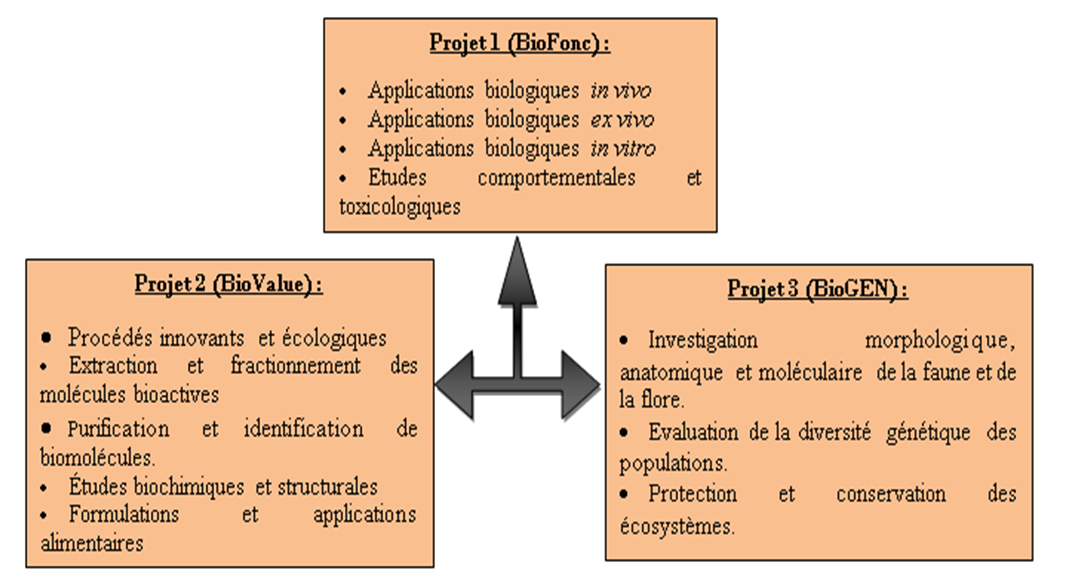
Interactions between LR projects.